Safety lapses often start small—misplaced tools, skipped PPE, a rushed shortcut. But these minor oversights compound, and before long, someone gets hurt. Prevention starts with consistent communication, and nothing cuts through complacency like a well-run toolbox talk. For safety coordinators, supervisors, and team leaders, free downloadable safety toolbox talks are essential tools: accessible, actionable, and instantly deployable.
These brief safety discussions—typically 10 to 15 minutes—target specific hazards and reinforce safe behaviors on the job site. When they’re downloadable and free, they remove barriers to implementation. No reinventing the wheel. No expensive subscriptions. Just practical, relevant content that keeps teams informed and protected.
Here’s how to find, use, and maximize free safety toolbox talks—without sacrificing quality or compliance.
What Are Safety Toolbox Talks (and Why They Matter)
Toolbox talks are informal safety meetings held at the job site before work begins. They focus on one specific safety topic—like ladder safety, electrical hazards, or fall protection—and encourage team discussion. Unlike lengthy training sessions, these are concise and situational, often prompted by immediate job conditions or recent incidents.
They matter because:
- They reinforce safety culture daily.
- They address real-time risks before work starts.
- They engage workers in safety conversations.
- They create a paper trail for compliance audits.
OSHA doesn’t mandate toolbox talks by name, but they directly support regulatory compliance under General Duty Clause and training requirements. For example, 29 CFR 1926.21(b)(2) requires employers to instruct employees on job hazards—exactly what toolbox talks do.
Free downloadable versions make this easier. Instead of drafting from scratch, safety professionals pull ready-made, professionally written talks, print or distribute them, and lead a discussion. Done right, it takes less than 20 minutes.
Key Features of High-Quality Downloadable Toolbox Talks
Not all free resources are created equal. Many so-called “free” talks are poorly written, lack actionable steps, or are clearly AI-generated filler. The best downloadable safety toolbox talks include:
- Clear title and hazard focus – e.g., “Preventing Back Injuries During Manual Lifting”
- Hazard description – plain-language explanation of the risk
- Real-world examples – scenarios workers might encounter
- Prevention strategies – specific actions to reduce risk
- Discussion questions – prompts to engage the team
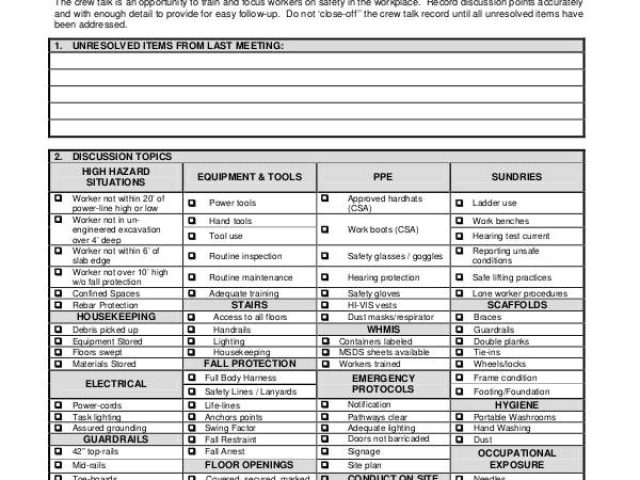
- Sign-off section – space for attendees to initial or sign
- Compliance alignment – references to OSHA or industry standards
For instance, a quality fall protection toolbox talk shouldn’t just say “use harnesses.” It should explain how harnesses fail when improperly anchored, show the correct D-ring placement, and ask workers when they’ve seen fall protection misused on site.
Avoid talks that are overly generic, lack discussion prompts, or don’t include a sign-in sheet. Without attendance records, you lose documentation critical during audits.
Top Sources for Free Downloadable Safety Toolbox Talks
You don’t need a six-figure safety budget to access high-quality content. Several reputable organizations offer free, ready-to-use toolbox talks—completely downloadable in PDF or Word format.
Here are five trusted sources:
| Source | Format | Topics Covered | Notes |
|---|---|---|---|
| NIOSH (CDC) | Chemical exposure, ergonomics, heat stress | Science-backed, public domain | |
| OSHA.gov | PDF, HTML | Fall protection, PPE, trenching | Official, compliant, no frills |
| Canadian Centre for Occupational Health and Safety (CCOHS) | Mental health, noise, confined spaces | Bilingual, globally relevant | |
| SafetyInfo.com | PDF, editable Word | Over 200 topics | Veteran-created, practical tone |
| HSE UK (Health and Safety Executive) | Slips/trips, working at height, plant safety | Internationally respected |
Each of these offers genuine value. NIOSH talks include data from real injury studies. SafetyInfo.com provides editable files—critical if you need to customize for site-specific risks. HSE UK documents are especially useful for multinational teams.
Some sites require email sign-up, but the best ones—like OSHA and NIOSH—offer direct downloads with no gatekeeping.
How to Customize and Implement Free Talks
Downloading a toolbox talk is step one. Making it effective is step two.
Most sites deliver generic content. That’s fine—until you’re talking about fall protection on a telecom tower and your crew works in food processing. One-size-fits-all doesn’t work.
Here’s how to adapt:
- Replace generic examples with site-specific scenarios.
- Example: Instead of “a worker on a roof,” say “when changing filters on the third-level ductwork.”
- Add local rules or procedures.
- If your site requires double-checking harness anchor points with a supervisor, include that step.
- Insert photos or diagrams.
- A labeled image of correct lifting posture beats a paragraph of description.
- Update the date and job site.
- Always include the location and date on the sign-off sheet.
- Translate if needed.
- Use tools like Google Translate (with human review) for multilingual crews.
One manufacturing plant reduced hand injuries by 40% in six months after customizing generic pinch-point talks with photos of their own machinery. The familiarity made the hazard real.
Common Mistakes That Undermine Effectiveness
Even the best free resource fails when implemented poorly. Watch for these traps:
- Reading aloud like a script – Toolbox talks should spark discussion, not lecture. Stop after each section and ask, “Has anyone seen this happen here?”
- Using the same topics repeatedly – Rotate content monthly. A construction crew might need crane safety one week and hot work permits the next.
- Skipping attendance records – No signature, no proof. Always collect names and roles.
- Scheduling at the wrong time – Right after shift start, workers are distracted. Hold talks just before task initiation.
- Ignoring worker feedback – If employees suggest a topic (e.g., “our break room floor is always wet”), use it next time.
One supervisor at a warehouse used the same “slip and fall” talk every Monday for three months. Engagement dropped, attendance wavered, and two months later, a worker slipped on an oily patch near the loading dock—exactly the hazard the talk was supposed to prevent.
The issue wasn’t the content. It was the delivery.
Integrating Toolbox Talks Into Your Safety Workflow
Free downloadable talks shouldn’t be one-offs. They work best when embedded into a consistent safety rhythm.
Try this weekly workflow:
- Monday AM: Download or select the week’s topic (e.g., “Noise Exposure in High-Volume Areas”)
- Tuesday: Customize with site-specific details
- Wednesday: Distribute to crew leads for preview
- Thursday: Deliver talk at morning huddle
- Friday: File signed copies and log topic in safety register
Use a rotating schedule. Track topics monthly to avoid repetition. After 12 months, you’ll have covered core hazards at least once—and likely triggered dozens of safety conversations.
Digitize when possible. Store PDFs in a shared drive labeled by hazard type. Use tablets or printed handouts on-site. Some teams even email talks to crew leads the night before so workers can read ahead.
Real-World Use Cases That Show Impact
Toolbox talks aren’t theoretical. When used well, they prevent incidents.
Case 1: Commercial Roofing Crew After a near-miss involving a dropped tool, the foreman downloaded a “Struck-By” toolbox talk. He added a photo of the actual tool and discussed how wind could turn even a small wrench into a projectile. The crew began using tool lanyards the next day. Zero dropped objects in the next 8 months.
Case 2: Manufacturing Line A safety officer noticed rising fatigue complaints. She used a free mental health toolbox talk from CCOHS, reworded it to reflect shift patterns, and encouraged anonymous feedback. Three workers later requested schedule adjustments—preventing potential errors from fatigue.
Case 3: Municipal Road Crew Before starting a night paving job, the lead ran a “High-Visibility Clothing” talk. One worker admitted his vest was in the shop for repairs. The team issued a backup—avoiding a potential citation and reducing exposure risk.
In each case, a free, downloadable talk—slightly customized—created real behavioral change.
Final Thoughts: Make Safety a Daily Conversation
Free downloadable safety toolbox talks are more than convenience tools—they’re force multipliers for safety leadership. The best ones save time, meet compliance needs, and keep critical hazards at the front of workers’ minds.
But they only work when used consistently, customized thoughtfully, and discussed—not just read.
Your next toolbox talk doesn’t need to be perfect. It just needs to happen. Download one today, tailor it to your site, gather your team, and start talking. That conversation might be the reason no one gets hurt tomorrow.
Frequently Asked Questions
Where can I find free safety toolbox talks in PDF format? Reputable sources include OSHA.gov, NIOSH, SafetyInfo.com, and CCOHS. All offer free, downloadable PDFs with no registration required.
Are free toolbox talks OSHA-compliant? Yes, if they address recognized hazards and include documentation. Always verify content aligns with OSHA standards like 29 CFR 1910 or 1926.
Can I edit free toolbox talks for my workplace? Absolutely. Editable Word versions from sites like SafetyInfo.com allow customization for site-specific risks, procedures, and language.
How often should toolbox talks be conducted? Weekly is ideal. At minimum, conduct them monthly or after incidents, near-misses, or process changes.
Do toolbox talks need employee signatures? Yes. Signatures serve as proof of training and attendance, essential for audits and incident investigations.
What topics should I cover in toolbox talks? Focus on common hazards: PPE, slips/trips, electrical safety, fall protection, equipment use, and emergency response. Rotate topics monthly.
Can toolbox talks reduce workplace injuries? Yes. Regular, relevant discussions increase hazard awareness and promote safe behaviors, directly reducing incident rates.
FAQ
What should you look for in Free Downloadable Safety Toolbox Talks for Any Workplace? Focus on relevance, practical value, and how well the solution matches real user intent.
Is Free Downloadable Safety Toolbox Talks for Any Workplace suitable for beginners? That depends on the workflow, but a clear step-by-step approach usually makes it easier to start.
How do you compare options around Free Downloadable Safety Toolbox Talks for Any Workplace? Compare features, trust signals, limitations, pricing, and ease of implementation.
What mistakes should you avoid? Avoid generic choices, weak validation, and decisions based only on marketing claims.
What is the next best step? Shortlist the most relevant options, validate them quickly, and refine from real-world results.